Showing posts with label Mangyan. Show all posts

Thursday, October 02, 2014

Old RA is the New RA

3 fonts updated w/ RA and minor clean up.
Mangyan Fonts Update:

I have been meaning to upload the updated Mangyan fonts with the new RA character. So here it is: DOWNLOAD (.zip file containing 3 .ttf files)

Last year the Mangyan people's leaders opted to reintroduce the older Hanunuo RA letter-form based on the LA character (with a minor modification on the rightmost up & down end strokes). They retired Antoon Postma's dash RA that was based on the Buhid variant of Surat Mangyan. New publications from the Mangyan Heritage Center (MHC) www.mangyan.org started to include the updated character earlier this year, starting with the Surat Mangyan Primer.

I'll update the individual .zip files in each of the font's DeviantArt download hosting later since I still need to update the keyboarding charts for them.

The Postma dash RA and its vowel modifiers (kudlit) are still included in the fonts. Accessed by typing the Uppercase R, 7, and 8 keys. The new RA and its kudlit are now currently set to the lowercase r, (, and ) keys.

A custom keyboard layout for Mangyan script is in the works for Windows 8 and Mac OSX. I just need to optimize the Hanunuo Unicode font and finish up a Buhid font/typeface that will share some of its Unicode range with Hanunuo for similar kudlit positions. The keyboard layout will probably be ready before the end of this year.

I'm also working on a Surat Mangyan children's coloring book for the MHC.

Updated Chart for the Mangyan Postma Font.

...

If you're looking for another Unicode compliant font,  Google's Noto Sans have both Hanunuo and Buhid here:

https://www.google.com/get/noto/#sans-hano
https://www.google.com/get/noto/#sans-buhd

...

Sunday, April 06, 2014

Saving Baybayin through Technology, Typography, and Standardization.

I was in attendance at the International Workshop on Endangered Scripts of Island Southeast Asia last month (Feb. 27 - Mar. 1) in Tokyo, Japan. Hosted by Linguistic Dynamics Science Project (LingDy), a strategic project of the Research Institute for Languages and Cultures of Asia and Africa (ILCAA), at the Tokyo University of Foreign Studies (TUFS).

The workshop discussed the writing systems and traditions of Southeast Asia, focused on (but was not limited to) the endangered Indic scripts of the Philippines, Sumatra and Sulawesi. We presented our papers which covered topics regarding historical and structural relationships, literature, documentation, revival, modern functions, adaptations and social/cultural meaning.

In addition to the academic component of the workshop, the organizers encouraged participation by culture-bearers, activists, and artists - this is how we got included.

Philippine script representatives:

- Kristian Kabuay (Baybayin.com)
- Anya Postma (Mangyan Heritage Center)
- Kanakan Balintagos (Solito Arts Productions)
- Norman de los Santos (BHM Publishing House, Inc.)
- Emerennciana Lorenzo Catapang (Mangyan Heritage Center)
- Christopher Miller (Independent Researcher, Montreal, Canada)
- Bruno Tiotuico (Alexandre Dayrit Tiotuico) (Ágúman Súlat Kapampángan)
- Michael Raymon M. Pangilinan (ILCAA, Tokyo University of Foreign Studies)

From left to right: Mr. Christian Cabuay (a.k.a. Kristian Kabuay, Baybayin Artist, Calligrapher, Entrepreneur), Mrs. Emily Lorenzo Catapang (Executive Director of the Mangyan Heritage Center), ME: Norman de los Santos (a.k.a. Nordenx, Baybayin Typographer, Graphic Designer), and the young Mr. Bruno Tiotuico (Sulat Kapampangan activist, Photographer).


From left to right: Ms. Anya Postma (Sulat Mangyan advocate and Daughter of anthropologist and linguist Antoon Vreeze Postma), Mr. Christopher Ray Miller (Linguist, scholar, and expert on Philippine and SouthEast Asian scripts), Mr. Auraeus Solito( a.k.a. Kanakan Balintagos, internationally acclaimed and award-winning filmmaker and indigenous peoples rights advocate) and Mr. Michael Raymon Pangilinan (a.k.a. Siuálâ ding Meángûbié, Kapampangan Culture activist, scholar, and author of "Kulitan")

The abstracts and proceedings of everyone who presented can be accessed here: http://lingdy.aacore.jp/en/activity/endangered-scripts-issea/docs.html

My well-received handout on Baybayin Typography and Standardization.

My paper and abstract are available at the LyngDy page linked above.

My handout is available here:
Note: You can download and print a copy of the handout image above for your own personal use. However, please don't publish or distribute this image commercially without prior consent or licensing from the author.

The workshop answered a lot of questions regarding the history & relationships of SEA scripts and Philippine scripts. It opened up a lot of ideas and it offered up a lot of insight and exchange between academic and non-academic culture bearers. Expect that my experience and what we've learned in Tokyo will work its way into my font development.


Essential Links:

https://www.facebook.com/groups/surat2014/

http://blog.baybayin.com/2014/01/30/event-japan-tokyo-university-of-foreign-studies/

http://lingdy.aacore.jp/en/activity/endangered-scripts-issea.html

http://www.mangyan.org/

http://siuala.com/


http://www.angkulet.com/2012/10/25/auraeus-solitos-baybayin-first-trailer/#sthash.i70lMHOr.dpbs


...

Sunday, June 03, 2012

Surat Mangyan UPDATE

Big update for Surat Mangyan fonts!

First off, a brand new font:
  • Buhid Script v.1.0

Download set from: http://Nordenx.deviantart.com/art/Mangyan-Buhid-Font-306046314

Next, major updates for existing Mangyan fonts:

Hanunuo Fonts UPDATED to v.2.00
* New kudlit position for Wu assigned to the 9 key
* New keystroke for Di assigned to Ae
* New kudlits assigned & extended to Buhid Unicode range
* Various internal file info & settings cleaned up
* New pakudos symbol assigned to the # key

Download set from: http://nordenx.deviantart.com/art/Mangyan-Hanunoo-Postma-Font-252407086


Download set from: http://nordenx.deviantart.com/art/Mangyan-Hanunoo-Brush-Font-169880405


Download set from: http://nordenx.deviantart.com/art/Mangyan-Hanunoo-Font-149145096


What's up with kudlits being assigned & extended to the Buhid Unicode range?

When the original proposal to assign blocks of Unicode ranges was sent out to the Unicode Consortium, the people responsible did not ask for 28 more reserved spaces (14 for Buhid, 14 for Hanunuo) that should've covered the 14 unique kudlit positions required by different characters per both Buhid & Hanunuo scripts. Once the ranges were locked in, it has now become next to impossible to request or make drastic changes in the Unicode block.

Working around this limitation, I have devised a Unicode range redistribution plan for all Nordenx Baybayin fonts. -> DOCUMENTATION <-

The first test of this redistribution is underway via a new Surat Mangyan Unicode Typepad:


Please, test drive it and see what you think. :)

...
Enhanced by Zemanta

Friday, August 12, 2011

Mangyan Postma Font

Mr. Antoon Vreeze Postma is a Dutch anthropologist and linguist who has married into and has been living for more than fifty years among the Hanunuo Mangyan tribe in Mindoro, Philippines. He is best known for being the first to decipher the Laguna Copperplate Inscription, and for documenting the Hanunóo script, paving the way for its preservation. He is the founder of the Mangyan Research Center in Panaytayan, Mansalay, Mr. Postma is in charge of the (MHC) Mangyan Heritage Center's research operations. His collection forms the bulk of the materials in the MHC library.

I visited the MHC in my home town of Calapan City, Oriental Mindoro, last year (August 2010). I purchased several of Postma's books and watched how they still use handwriting to record and catalog Ambahan poetry and other learning materials. I showed Mrs. Emily Lorenzo Catapang (Executive Director of MHC) how to instal and use Mangyan fonts on their computers so that they can have a modern alternative way of publishing materials. I promised to continue developing and perfecting fonts for Surat Mangyan for the very purpose of propagating and preserving the written cultural heritage of the Mangyan.

This new font was inspired by Postma's works. Baybayin Mangyan Postma Type has bold and uniform strokes best suited for posters and other print. This font is based on one of Postma's book cover art.

New Mangyan Font:

Download this font set from: http://nordenx.deviantart.com/art/Mangyan-Hanunoo-Postma-Font-252407086
--------------

Mangyan Fonts from 2010:

Download this new font set from: http://nordenx.deviantart.com/art/Mangyan-Hanunoo-Brush-Font-169880405


Download this font set from: http://nordenx.deviantart.com/art/Mangyan-Hanunoo-Font-149145096

--------------
Enhanced by Zemanta

Sunday, July 17, 2011

Horrified with Modified

As I release western style baybayin fonts, I begin to wonder about how the community will receive them.
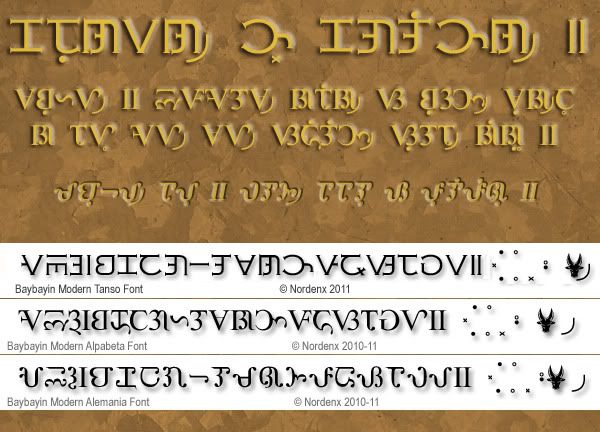
Western Style Baybayin Typefaces

Over the years, I received numerous emails and private messages regarding my fonts and my efforts in standardizing the script for typography, uniformity of stokes, ease of legibility, ease of access, and synchronization with modern Filipino orthography. A lot of these correspondences are positive and very encouraging. However there a a few that are not. It seems that I have not made my intentions clear. People sometimes see the adjective "modern" in the name of my fonts and they immediately think "modified" which  some view with the same disdain they feel when they think that something is a product of "colonial mentality".

Modern Modified

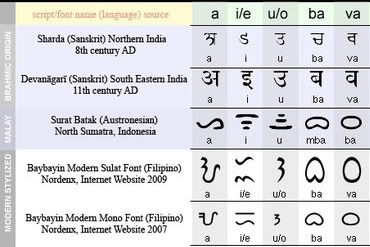
Ra Rah! To tell you the truth, the only glyph I consider "modified" in my fonts is my ᜍ Ra character. But even ᜍ Ra as an alternative character is basically still an embellished "traditional" ᜇ Da. Maybe that's why folks accept it; I'm just pleasantly pleased that it has been well received by many. In that light, my other "alternative" characters are designed in the same fashion; an embellished ᜐ Sa for Za, an embellished ᜁ I for E, and an embellished ᜂ U for O.

Ba Va Boom! Some folks are confused by my other characters which are actually NOT embellished versions of the another (Filipino) phoneme equivalent but are actually true (earlier recorded) representation of the same character; O Ba is the same ᜊ Ba but I assigned the round O Ba to the 'V' key because it more resembles the phoneme matching characters in related family of Indic & South East Asian scripts.

Oye Pa Fa! The traditional F-shaped ᜉ Pa is still the same as the old Kapampangan closed-loop P-shaped Pa so I assigned the F-shaped one to the 'F' key and the P-shaped one to the 'P' key [shape-wise it makes sense to me] - however, the old closed-loop Ya is very much similar to the old closed-loop Pa, so I chose to include & assign a current but still traditional loop-less ᜌ Ya to the 'Y'  key.

e, ang kulit o! People fail to see that even if I propose and include these alternatives, they are available to them only if they wish to use them. If you like the style of a font and want to write in the old traditional way - you can do so. It's there for you, it's free, it's easy! Just because I included the hollow ○ kudlit mark for mid vowels e and o doesn't mean you have to use them or even disregard the whole font just because you think that the solid ● kudlit mark is the proper mark (I'll get to you 'mix & dash' supporters later). Same goes to the virama and pamudpod (vowel cancellation marks), I included them because they are culturally & historically relevant. Just because they are introduced by foreigners doesn't mean that they are linguistically wrong. Virama and pamudpod marks are valid methods of vowel cancellation used by baybayin's parent Indic & relative Malay/Austronesian scripts. The virama method is very old but still very effective. Heck, it was introduced to baybayin by the Spanish scholars for the very same reason I saw it fit for use - to adapt with changing times.

Adobo at pandesal... More than 300 years of Hispanic and western influence has infused and change our culture and language. Good or bad, these influences have become uniquely and traditionally ours. The krus kudlit (cross-shaped virama) was introduced in the 16th century to adapt baybayin script to Spanish orthography, and despite the native population's adamant reluctance to use it for everyday writing, they conceded to use it when writing Spanish words. After several centuries, like adobo & pandesal, our language & culture adapted and changed, but baybayin never did. Could the early practitioner's staunch tradition and resistance to change have contributed to baybayin's disuse? The krus kudlit is as old as the introduction of the word adobo and the bread pandesal to Filipinos and while the food stuff became "traditional" Filipino fare, the cross-shaped mark became a hated symbol of Spanish oppression - a funny thing coming from a country of devout Catholics.
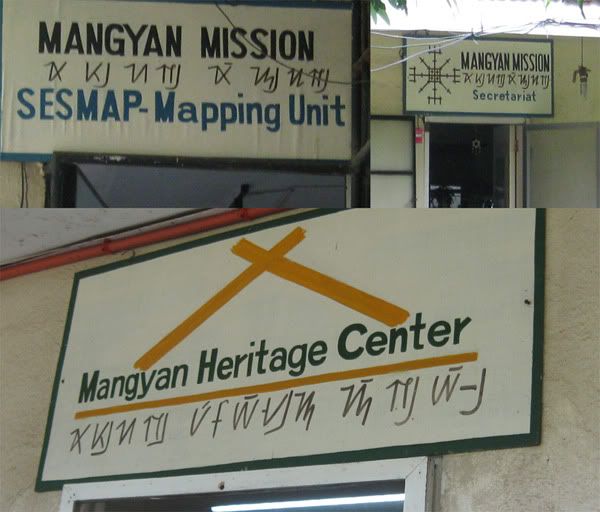


pud! galoryus pud!
What's fresh and what's cooking? Being from Mindoro Island, the home of the Mangyan tribes, I have been interested with the pamudpod; their version of a virama. The pamudpod mark and a Ra character were introduced  several decades ago by Dutch anthropologist Antoon Postma, who has married into and lives among the Hanunóo, a Mangyan sub-tribe in Mindoro, Philippines. What interests me is how readily the Mangyan accepted and implimented this marks & method of canceling inherent vowels. As you can see from the photo-collage above from my visit to Mindoro last year (2010), it is now commonly used everyday by the tribes. All Mangyan books, souvenir nicknacks, shirts, handicrafts and artifacts I encountered back home bears the newly introduced mark & character. This is especially true when a Mangyan language composition is mixed with Tagalog, and foreign words. This is another reason why I included a Ra and pamudpod mark in my fonts.

BOTTOM LINE:

Just because my fonts have the adjective 'modern' attached to its name and the characters have been stylized, it doesn't mean that they can not be used in the traditional way of baybayin. Each character in all my fonts retain the traditional character form & shapes.

I also can't stress enough that you learn both the traditional method & Spanish "reformed" method of writing baybayin and educate yourself about Filipino languages and orthography.

Paul Morrow's site is the best place to start: Sarisari etc.

And don't forget to check out the other links listed on the sidebar of this blog.
Enhanced by Zemanta

Saturday, July 03, 2010

Surat Mangyan Brush Font

New Mangyan Font:

Download this new font set from: http://nordenx.deviantart.com/art/Mangyan-Hanunoo-Brush-Font-169880405


Updated Mangyan Font:

Download the updated file from: http://nordenx.deviantart.com/art/Mangyan-Hanunoo-Font-149145096

Font updated to v.1.50
  • Unicode ranges transferred from Tagalog to Hanunóo
  • Finished welding and verifying all glyphs
  • Various cleanup and re-alignments


A Brush with Fate (Baybayin Sighting)
During my quick and short visit to my home province of Mindoro last year (May, 2009), I spotted this poster on a wall inside a restaurant in Calapan City.

I don't know who the artist/writer was but I am quite intrigued with his/her use of Hanunoo script. I am not sure if this poster actually is written in the Mangyan language; I can read the script alright, but it only seem like gibberish to me. It does not seem to be written in Tagalog and I don't fully understand Mangyan so I can't truly be sure what it says.

Anyway, it's been a year since and I am going back to the Philippines this July 9, 2010 and will be staying until Aug. 28, 2010. I plan to visit the Mangyan Heritage Center in Calapan City sometime during my stay there. Maybe I can ask someone over there to translate this poster to me.


Anyway, this poster is one of the inspirations for the new brush-style font. I was also looking at other examples of Hanunóo handwriting (not carving).

What's new?
Like the previous Hanunóo font, I included the pamudpod as well as the cross kudlit or virama. To access the pamudpod use the equal key ( = ) and to access the virama use the plus key ( + ).

There is a new kudlit system?
The Nordenx fonts are created so that a standard western keyboard can easily access the baybayin characters. However, please note that the Mangyan script have different kudlit positions depending on what character is used. These different kudlit positions can be accessed by typing the keys for e, i, o, u, 1, 2, 3, 4, 5, and 6 (see sample image in the download page). Using these keys, you can easily and accurately position your kudlits to write the proper Mangyan syllables. To render kudlit in the classical baybayin i/e & o/u locations, just use the i an o keys respectively.

Hanunóo script is used in writing ambāhan - I think it's time to learn how to write these epic poems.


...

Tuesday, June 08, 2010

Download Free Modern Baybayin Fonts

Download Free Baybayin Modern Fonts

PLEASE GO TO THE DOWNLOAD PAGE FOR A MORE UPDATED LIST.

Download Free Baybayin Modern Fonts

Note: even though the style of these fonts are modern, you can still use it to write in the traditional way.

The updated font files are hosted in deviantART. If you download them from any other font-collective websites, keep in mind that they may not be the most up-to-date version of the file.

In the deviantART page for each font, look for the download link in either the text description or the download arrow button located at the upper-right side of the page.


FAQ: How to install these fonts on your computer? Click Here for Answer

All of Nordenx Baybayin Modern Fonts are for personal and non-commercial use only. Please contact me at nordenx@yahoo.com for any inquiries about commercial use in publications or electronic applications.

To try-out any of these fonts before you download them, use this typepad: Baybayin Fonts Typepad

Previews & Download Locations of available fonts:


Download this font set from: http://nordenx.deviantart.com/art/Baybayin-Modern-Bern-Font-253861545


Download this font set from: http://nordenx.deviantart.com/art/Baybayin-Modern-Tanso-Font-241218356


Download this font set from: http://nordenx.deviantart.com/art/Baybayin-Modern-Alemania-Font-241209530


Download this font set from: http://nordenx.deviantart.com/art/Baybayin-Modern-Alphabeta-Font-241191137


Download this font set from: http://nordenx.deviantart.com/art/Baybayin-Modern-Club-Font-231829356


Download this font set from: http://nordenx.deviantart.com/art/Baybayin-Modern-Ringo-Font-221118715


Download this font set from: http://nordenx.deviantart.com/art/Baybayin-Modern-Jepoy-Font-231576002


Download this font set from: http://nordenx.deviantart.com/art/Baybayin-Modern-Gana-Font-225516266


Download this font set from: http://nordenx.deviantart.com/art/Baybayin-Modern-Kana-Font-184288362


Download this font set from: http://nordenx.deviantart.com/art/Baybayin-Modern-Damo-Font-184637586


Download this font set from: http://nordenx.deviantart.com/art/Baybayin-Modern-Sinta-Font-150968942


Download this font set from: http://nordenx.deviantart.com/art/Baybayin-Modern-Mono-Font-150969288


Download this font set from: http://nordenx.deviantart.com/art/Baybayin-Modern-Mindoro-Font-149015455


Download this font set from: http://nordenx.deviantart.com/art/Batbayin-Modern-Brush-Font-148846227


Download this font set from: http://nordenx.deviantart.com/art/Baybayin-Modern-Divine-Font-148108328


Download this font set from: http://nordenx.deviantart.com/art/Baybayin-Modern-Sulat-Font-147024184


Download this font set from: http://www.deviantart.com/deviation/40485497/


Download this font set from: http://www.deviantart.com/deviation/40485871/


Download this font set from: http://www.deviantart.com/deviation/40485989/


Download this font set from: http://www.deviantart.com/deviation/40486111/


Download this font set from: http://www.deviantart.com/deviation/58810506/

--------------

Mangyan Fonts:

Download this font set from: http://nordenx.deviantart.com/art/Mangyan-Hanunoo-Postma-Font-252407086


Download this new font set from: http://nordenx.deviantart.com/art/Mangyan-Hanunoo-Brush-Font-169880405


Download this font set from: http://nordenx.deviantart.com/art/Mangyan-Hanunoo-Font-149145096

--------------

Kapampangan Fonts:


Download this font set from: http://nordenx.deviantart.com/art/Baybayin-Pamagkulit-Font-246309064

Watch this video tutorial on "How to type Kapampangan script (Kulitan) vertically in Microsoft Word using the Pamagkulit Font inside a table." Please watch it in Full Screen Mode to see the details:


--------------

~How to install these fonts on your computer:


The fonts are in compressed (.zip files). The latest Operating Systems (OS) are now able to open these in their own folders when you click on the file. If your computer is older and unable to open these files, then you will need a utility such as WinZip or WinRar to uncompress them. Download a free evaluation version of WinZip or WinRar.

Each zip file contains the true type font file (.ttf) and a text file (.rtf) that contains aditional info about the font and its use & features; please read it.

You can extract (uncompress) the font file directly to your C:\WINDOWS\Fonts folder if you want or you can extract it to a temporary folder then follow the font installation instructions can be found at MyFonts.com or from Paul Morrow's Site.

For Windows 7 / Vista users:
  • Right-click the font file(s) and choose Install.
For users of the previous Windows versions:
  • Copy the included file(s) into a default Windows font folder (usually C:\WINDOWS\FONTS or C:\WINNT\FONTS)
For Mac:
  • Expand any compressed fonts packages.
  • Double-click the icon of the font file you want to install. The Font Book will open and display the font so you can preview it.
  • By default, the application installs the font in the Library folder of your home directory, making it available only to you. To make it available to all users on the computer, from the Font Book menu, select Preferences... , and then change the "Default Install Location:" from User to Computer.
  • Click Install Font.

A Note On Baybayin Styles and Names
Although there are many forms of the baybayin, it must be remembered that they are not unique to the languages that share their names. That is to say, the baybayin, like our modern alphabet, can be written or printed in many ways and each style can be used to write in any language. Just as italic printing is not only for Italian, a so-called Tagalog baybayin is not just for Tagalog or a supposed Ilokano script only for Ilokano etc.
The baybayin is a single writing system. The confusion between the forms of the baybayin and various Filipino languages may be due to historical circumstances or just sloppy reporting on the part of some historians. For example, the typeface chosen by Father Francisco Lopez in 1620 to print the Ilokano version of the Doctrina Christiana looks different to the one used in the Tagalog version of 1593 but they are both just two styles of the one baybayin. However, the Lopez typeface has since come to be mistaken in some circles as the “Ilokano alphabet” simply because it was used most notably in an Ilokano book.
Other forms of the baybayin such as Bikol and Bisaya have similar histories. Their origins can be traced only as far back as certain modern printed documents of the Spanish era that were written in their respective languages – their particular styles originating in the artistry of the authors. – PAUL MORROW


--------------