Showing posts with label Orthography. Show all posts

Friday, July 20, 2012

Modern Baybáyin Chart

Conservative Modern Reform:
(For review; as submitted, archived, and published in international linguistic academia.)
Modern Baybayin Chart
The image/chart above is my current draft for a standardized modern baybayin script.

...

The chart below lists the keystrokes for typing baybayin using fonts.

Modern Baybayin Chart

...

Any other character sets you'll find on your online searches that claims to be traditional or modern baybayin are most likely made-up or misleading. If I haven't linked or talked about them here in my blog, or you can't verify them via respectable baybayin sites like Paul Morrow's or Kristian Kabuay's, then more likely those sets are not accepted by the community of baybayin practitioners & experts.

Any other sets of characters that include special individual characters for C, Q, Ch, Th, Z, J, and or Ñ instead of character combinations are suspect and most likely are made-up (conscript). And unfortunately, we have found out that the use of the word "Alibata" as a name or description of the scripts (without including the correction & acknowledging that the real name of the writing system is actually "baybayin") is more likely to be an indicator that the information or the character set is flawed.

My work on the indigenous Philippine writing system is well researched (for more than two decades). It is academically backed & published, traditionally mindful, typographically sound, and community & expert approved.

...

Sometimes, forgotten traditions are re-discovered.

Repeating Syllables in Baybayin

We make sure that these forgotten traditions are documented and revived as well as corrected. For example: the double top-down kudlit is being mistakenly used as a vowel cancellation method; there is a precedent that this is used differently by our ancestors. Instead of a vowel-killer, the double top-down kudlits are actually bi-vowel consonantal syllable repeaters: ᜊᜒᜓ = "bobi" ≠ "b"

...

Traditional Baybayin

...

Friday, April 27, 2012

Using Baybayin Fonts

Read & Write Baybayin First:

Baybáyin is NOT an Alphabet.
Baybáyin is NOT Alibata.
Baybáyin is an Abugida.

To avoid embarrassing typographical errors, it is really important to learn how to actually read & write Baybayin Script and know the rules of both Abugida & Filipino orthography (spelling and pronunciation) first.

Visit these pages:

How to write using Baybayin Script: English Instructions <-click & visit
How to write using Baybayin Script: Filipino Instructions <-click & visit
These are thorough tutorials by Paul Morrow on how to write using Baybayin script in the original Filipino and modified Spanish methods. These tutorials are the most reliable and concise instructions online.

How do I write my name in baybayin? <-click & visit
This is the most frequently asked question regarding the script. This page offers strategies for writing difficult non-Filipino words and names in the baybayin script.

"A mistake people often make is to assume that the baybayin is just a neat looking alphabet; all you have to do is learn how draw the letters and then spell out the words in the language of your choice, and substitute each modern letter with a baybayin letter. However, baybayin doesn't work like that. This is the difference between an alphabet and a syllabic writing system." ~ Paul Morrow 

SOURCE: Sarisari etc. - http://www.mts.net/~pmorrow/


Typing with Baybayin Fonts:

"Easy Keyboard Access" this is one of the main benefit of Baybayin FONTS; for convenient usage and typing in word processing & graphic editing softwares.

Most Common Mistake - Vowel Characters & Kudlit marks treated as an Alphabet:
Multiple instances of vowel characters and little to no kudlit marks are the usual tell-tale giveaway.


Source: http://felipeaira.i.ph/blogs/felipeaira/2008/10/11/matanglawin/


"Easy Keyboard Access" does NOT mean "go ahead and type anything and it will be correct".

When using either Paul Morrow Fonts or Nordenx Fonts, the capital letter keys (shift+) A, E, I, O, and U will type Vowel Characters (ᜀ, ᜁ, ᜂ). Each of these characters represent a stand-alone vowel SYLLABLE not just an alphabet or letter with a vowel sound.

Each Baybayin Consonant Characters are also singular SYLLABLES that already has a default /a/ vowel sound. A kudlit mark is added to the character to change the /a/ vowel sound to the other vowel sounds /e/, /i/, /o/, or /u/. This is done by typing the lower-case vowel letter keys (e, i, o, or u) after the consonant character. The kudlit mark (dot, slash, caret, or chevron, etc.) should appear above or below the character after you typed the lower-case vowel.

A virama mark (x-kudlit or pamudpud) is added to the character to cancel the inherent or default /a/ vowel sound to create a vowel-less consonant character (dead-consonant). The x-kudlit (a modern replacement for the krus-kudlit introduced in the Doctrina Christiana) is recommended for leading or stand-alone dead-consonants, the pamudpud (a virama used by the Mangyan tribes of Mindoro) for trailing dead-consonants.

The Keys to Baybayin Fonts:

When you know the rules and know how to read & write in Baybayin script, install one or a few Baybayin fonts in your computer then familiarize yourself where and in which keyboard key is each character or glyph assigned to (you can use this tool - click here). Typing Baybayin in wordprocessing or graphic editing softwares should be straightforward by then.

The Key to Baybayin Online:

Using Baybayin characters online like typing your status on facebook or in a chat client is a different story. Online, Baybayin fonts requires using the Unicode range which is normally not easily accessed by your regular keyboard. The Unicode range can only be accessed using a specialized program like an online tool/application of by changing your keyboard's settings.

Learn: "How to type Baybayin using Unicode." <- click here & visit


ᜀ Type uppercase 'A' = syllable character "A" (traditional) 
- Type lowercase 'a' = none * 
ᜁ Type uppercase 'I' = syllable character "I" (traditional) 
 Type lowercase 'i' = kudlit mark "i" (traditional) 
ᜂ Type uppercase 'U' = syllable character "U" (traditional) 
 Type lowercase 'u' = kudlit mark "u" (traditional) 

Type '=' or '+' for a krus or x kidlit virama (reformed)

ᜅ Type uppercase 'N' = syllable character "NGA" (traditional)
ᜈ Type lowercase 'n' = syllable character "NA" (traditional) 

ᜊ Type 'b' or 'B' = syllable character "BA" or "VA" (traditional)
ᜃ Type 'c', 'k', 'K' = syllable character "KA" or "CA" (traditional)
ᜇ Type 'd' or 'D' = syllable character "DA" or "RA" (traditional)
ᜄ Type 'g' or 'G' = syllable character "GA" (traditional)
ᜑ Type 'h' or 'H' = syllable character "HA" (traditional)
ᜎ Type 'l' or 'L' = syllable character "LA" or "RA" (traditional)
ᜋ Type 'm' or 'M' = syllable character "MA" (traditional)
ᜉ Type 'f' or 'F' = syllable character "PA" or "FA" (traditional)
ᜐ Type 's' or 'S' = syllable character "SA" (traditional)
ᜆ Type 't' or 'T' = syllable character "TA" (traditional)
ᜏ Type 'w' or 'W' = syllable character "WA" (traditional)
ᜌ Type 'y' or 'Y' = syllable character "YA" (traditional)

ᜍ Type 'r' or 'R' = syllable character "RA" (modern alternative)
ᜉ Type 'p' or 'P' = syllable character "PA" or "YA" (archaic)
ᜊ Type 'v' or 'V' = syllable character "VA" (alternative)
ᜐ Type 'z' or 'Z' = syllable character "ZA" (alternative)

ᜁ Type uppercase 'E' = syllable character "E" (alternative)
 Type lowercase 'e' = kudlit mark "e" (modern alternative)
ᜂ Type uppercase 'O' = syllable character "O" (alternative)
Type lowercase 'o' = kudlit mark "o" (modern alternative)

ᜐ Type 'C' = character combo "TSA" for 'cha' (reformed)*
ᜃ Type 'q' = character combo "KUWA" for 'qua' (traditional)
ᜃ Type 'Q' = character combo "KWA" for 'qua' (reformed)
ᜇ Type 'j' = character combo "DIYA" for 'ja' (traditional)
ᜇ Type 'J' = character combo "DYA" for 'ja' (reformed)
ᜃ Type 'x' or 'X' = character combo "KSA" for 'xa' (reformed)
ᜈ Type '~' = character combo "NYA" for 'ña' (reformed)

 * may differ or not be available (yet) in some fonts.

Mind What You Type:


Common Mistake - mixing methods: 
There are several modes of writing Baybayin, don't mix them together in one composition. Don't confuse your readers.

Common Mistake - not translating to a Filipino language or forcing foreign pronunciation & spelling:
Ideally, Babayin should be used primarily for Philippine languages. However, Baybayin has been known to be used by natives to write some Spanish and English (in "Pilipinized" spelling) words.  

Rules of thumb:
  • Use borrowed words sparingly and only if there are no available equivalent words for them in any Philippine language or even Spanish. If you have to use the word as it is, you should follow the official rules on how to Pilipinize the spelling & pronunciation of foreign or borrowed words and how to break-it-down into syllables as laid out by the  Philippine National Language Commission in the Balarila (Rules of Orthography).
  • If the word is an important scientific or technical term and you do not have a direct and official translation to any Philippine language or Spanish - don't Pilipinize the spelling and don't write it in Baybayin Script, use the Latin Alphabet instead.
  • If the word is a name of person (or organization) - don't Pilipinize the spelling and don't write it in Baybayin Script, use the Latin Alphabet instead - unless that person (or group) made known to you or the public how they write his/her name in Baybayin (or they personally requested you to do so); how one prefers their name spelled & pronounced is a personal issue.
Common Mistake - tackling acronyms & initials:

-> CLICK HERE <- for more info about using Baybayin Script in Acronyms & Initialism.

...
Enhanced by Zemanta

Sunday, April 25, 2010

LCI's 1110th anniversary

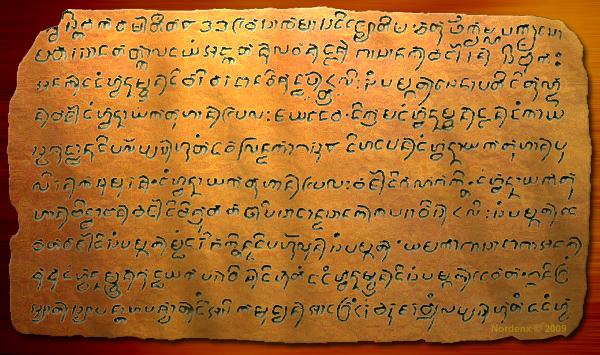
"April 21st 2010 marked the 1110th anniversary of the oldest known written artifact from the Philippines, the Laguna Copperplate Inscription (LCI). 1110 years ago on this date (April 21st of the year 900 in our era), the original legal document was written that forgave a debt held by a person living in the general area now occupied by metropolitan Manila." ~ Christopher Miller
Learn more about the Laguna Copperplate Inscription [click here]
Did you know that the LCI contains enough glyphs that fills an almost complete chart for old Javanese/Kavi? The image below contains all the deciphered glyphs found in the LCI:

Though a lot of details & characters are still missing, one only needs to take a look at the parent and related writing systems like Sanskrit and Old Javanese to figure out how rich and complex our ancestor's (proto-baybayin) writing system was prior to the emergence of the more simplistic classical baybayin script.

A couple of features that stand out from the LCI is that the Javanese Srivijaya inhabitants of our pre-colonial archipelago used a virama (vowel cancellation mark), the same function as the cross kudlit except that the LCI virama is only used for a final vowel-less trailing consonant. As for a vowel-less leading consonants, the glyphs form syllables by consonant conjuncts or stacked where the initial glyphs' vowel is dropped; quite similar to other Indic/Brahmic scripts of Hindu inhabitants that co-existed with the Javanese society in the islands at the same era.

We can find glyphs for visarga and anusvāra in the LCI.

An anusvāra is a diacritic used to mark a nasalization used in a number of Indic languages. This eliminated the use of a virama on a nga glyph for that final ng sound.

A visarga is a diacritic used to mark a voiceless breath used in a number of Indic languages. Losing this diacritic may explain the lost 'h' on certain words in modern Tagalog orthography.

Instead of adding a diacritic on the final vowel of a word with a final stress, note that LCI uses a diacritic for a long "a" or ā on the leading syllable's glyph.

Along with the long ā, the LCI shows us that the ancient islanders have all of the markers needed for five vowel sounds plus another for "ai" and a simple and modern-like "period" punctuation mark.

Note the characters for "ra", "ja", and "sha"; nevermind the "ca" and "ña" - wonder why these glyphs from Kawi did not carry through to baybayin? Sanskrit (parent script for both baybayin and kawi) also has these phonemes covered. One has to ponder when, how, and why our spoken language changed so much that the letters for these sounds are dropped from our spoken & written language. What happened between the time of the LCI until the re-introduction of letters and matching phonemes after the arrival of westerners? A proto-baybayin script may have been developed by the people for their own social class' usage by emulating features of Old Kawi and Sanskrit (that were propriety to the ruling & religious class). If this is the case, then the disparity and disconnect between social classes already existed in our ancient society even before western corruption entered the scene.

The few examples of alternate or modified sub-scripted and super-scripted character glyphs and those that form character conjuncts are surprisingly varied and complex (like those of "ra" and "ya"), I wouldn't be surprised that there are more letter combinations that are possible but not recorded in the LCI; other artifacts with Kawi from outside of the Philippines could fill in those gaps. For more examples and info, see: Aksara Kawi or Omniglot.

.

*edit - Additional Info:
Note that the LCI glyphs are Old Javanese Kawi Script with just a few peculiar character variations. This is probably due to the way the characters on the Laguna plate seemed to have been hammered into cold copper instead of the characters being impressed into heated copper which was the norm in Java at the time.

Also, the language used in the Laguna Copperplate Inscription is a variety of Old Malay containing numerous loanwords from Sanskrit and a few non-Malay vocabulary elements from Old Javanese and Old Tagalog (Austronesian).

Other artifacts of interest:
* Kedukan Bukit Inscription
* Tanjong Tanah Code of Law

Resources:
Many thanks to Antoon Postma, Dr. Johann de Casparis, Hector Santos, Paul Morrow for sharing their translations and research about the LCI.

Thanks to linguist and SEA script expert Christopher Miller (Kiwehtin) for providing additional info (please read comments) and visit Tyro Blog.

Friday, February 19, 2010

In the works

Font clean up and Unicode updates are slowly coming along.

I'm still have writer's block, but chapters of my baybayin book already got more info (in my head) since I started getting and reading old books and manuscripts from the 1600s to the early 1900s.

I'm studying more about modern Filipino orthography to better understand and create new proposed rules on modern baybayin.

I think I finally broken down every character/glyph to it's basic elements and have a standardization solution. I will write down the proposed rules and theories in my book.

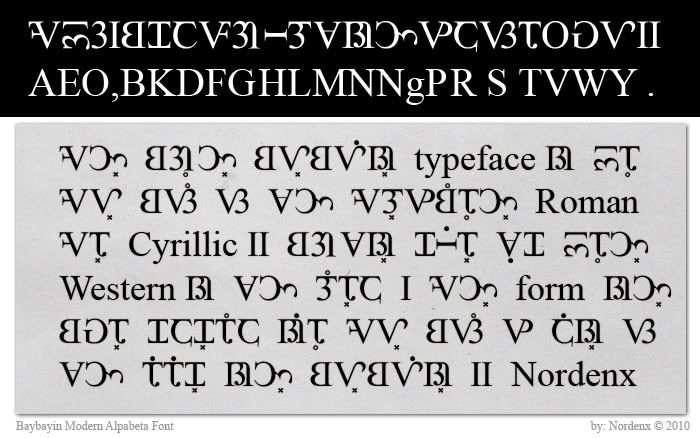
More unfinished fonts are waiting in the sidelines as I prioritize my projects. Here's one sample:

Enhanced by Zemanta