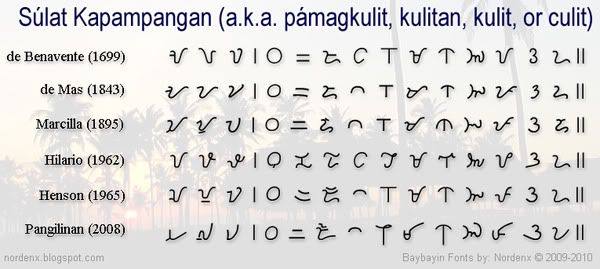
Kulitan differs slightly from Baybayin as it has been recently adapted solely for Kapampangan orthography. A different method of writing a combination of garlit (kudlit) diacritic marks with character ligatures & stacking is developed. Much of the character shapes originally were the same as Baybayin but through limited but continued use, Kulitan handwriting slowly evolved and in the recent decades they have changed to suit a vertical direction of writing popularized by current Kapampangan practitioners, scholars, artists, and academics.
Please review my previous blog entry about Súlat Kapampángan: Galit sa kulit - it explains some of the details about the Kapampangan method of writing.
NOW AVAILABLE! A NEW KAPAMPANGAN FONT! ~
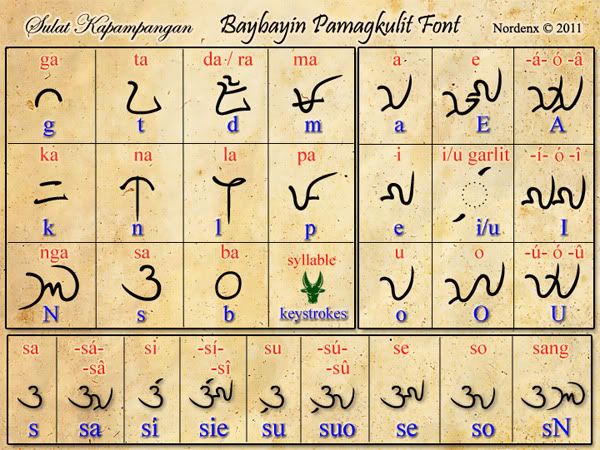
Download this font set from: http://nordenx.deviantart.com/art/Baybayin-Pamagkulit-Font-246309064
Watch this video tutorial on "How to type Kapampangan script (Kulitan) vertically in Microsoft Word using the Pamagkulit Font inside a table." Please watch it in Full Screen Mode to see the details:
NOTE: Tagalog, Mangyan Hanunóo, Magyan Buhid, and Tagbanua have assigned Unicode blocks or ranges; Kapampangan does not have any assigned to it.
...
For more info about Súlat Kapampángan, visit: Siuálâ Ding Meángûbié
...


5 comments:
keep up the good work :)
i think if there would be a unified national script in the near future, they should also consider kapampangan techniques of canceling the 'a' & the ability to use around 8 vowel sounds vs 3 in most other Phil. scripts
Tayag is an old Kapampangan word. But the script itself doesn't have 'y'. How do we write Tayag in Kapampangan? Please help...
Tayag, can be spelled as TAIAG
I wanted to get a tattoo saying "Pinoy Pride" or "Proud Pinoy" in this script, can anyone help me? I want to make sure it is properly done since a tattoo is permanent. Thank you.
Post a Comment